Generator Derating for Altitude and Heat
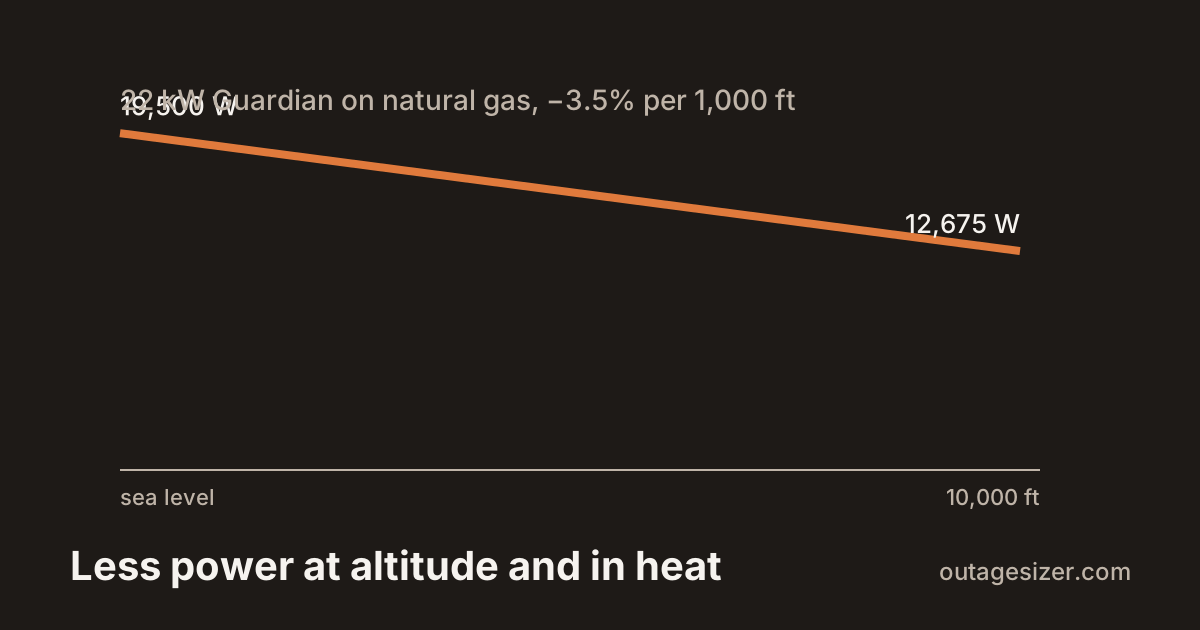
A generator makes less power in thin, hot air, and the loss is large enough to change which size a house needs. Generac's Guardian spec sheets give the rule in a footnote: "Maximum power decreases approximately 3.5% for each 1,000 ft (304.8 m) above sea level and approximately 1% for each 10 °F (6 °C) above 60 °F (16 °C)."
What the rule does to each size
Usable output on natural gas, in watts, by elevation (at or below 60 °F):
| Elevation | Factor | 10 kW | 14 kW | 18 kW | 20 kW | 22 kW | 24 kW | 26 kW |
|---|---|---|---|---|---|---|---|---|
| 0 ft | 100% | 9,000 | 14,000 | 17,000 | 18,000 | 19,500 | 21,000 | 22,500 |
| 1,000 ft | 96.5% | 8,685 | 13,510 | 16,405 | 17,370 | 18,818 | 20,265 | 21,713 |
| 2,000 ft | 93% | 8,370 | 13,020 | 15,810 | 16,740 | 18,135 | 19,530 | 20,925 |
| 3,000 ft | 89.5% | 8,055 | 12,530 | 15,215 | 16,110 | 17,453 | 18,795 | 20,138 |
| 5,000 ft | 82.5% | 7,425 | 11,550 | 14,025 | 14,850 | 16,088 | 17,325 | 18,563 |
| 7,000 ft | 75.5% | 6,795 | 10,570 | 12,835 | 13,590 | 14,723 | 15,855 | 16,988 |
| 9,000 ft | 68.5% | 6,165 | 9,590 | 11,645 | 12,330 | 13,358 | 14,385 | 15,413 |
At 5,000 feet the 22 kW unit, rated 19,500 W on natural gas, delivers about 16,088 W — less than the 18 kW unit's sea-level rating of 17,000 W. Someone near Denver's elevation sizing from a sea-level chart would come up one size short.
Heat
The same footnote takes away about 1% for every 10 °F above 60 °F:
| Air temperature | Factor |
|---|---|
| 60 °F | 100% |
| 80 °F | 98% |
| 90 °F | 97% |
| 100 °F | 96% |
| 110 °F | 95% |
Heat matters most for air conditioning: the outage that leaves a house without cooling on a 100 °F afternoon is the one where the generator has 4% less to give. Size for the hottest day you expect to run it.
Both together
This site adds the two percentages. At 5,000 feet on a 100 °F day: 17.5% + 4% = 21.5% off, a factor of 0.785. A 26 kW Guardian rated 22,500 W on natural gas then delivers about 17,663 W.
Why it matters more for standby units
Generac's rating definition for its standby units says: "Applicable for supplying backup power for the duration of the utility power outage with correct maintenance performed. No overload capability is available for this rating." There is no surge margin above the rating, so the derated figure has to cover the running load plus the biggest starting surge outright. Portable generators also lose power at altitude, but the makers of the six portables on this site do not publish a derate on the pages used here, so the calculator applies the derate only to standby sizing.
Worked example
A house at 5,000 feet needs 17,500 W to run its list and start its biggest motor, on natural gas.
- 18 kW: 17,000 × 0.825 = 14,025 W — short.
- 20 kW: 18,000 × 0.825 = 14,850 W — short.
- 22 kW: 19,500 × 0.825 = 16,088 W — short.
- 24 kW: 21,000 × 0.825 = 17,325 W — short.
- 26 kW: 22,500 × 0.825 = 18,563 W — fits.
At sea level the same list would fit the 20 kW. Enter your elevation and hottest outage temperature in the calculator and it applies the derate before picking a standby size. Derating for altitude and heat moved this house up three sizes, so do it before choosing a generator.
Sources
Questions
How much power does a generator lose at altitude?
Generac's spec sheets say maximum power decreases approximately 3.5% for each 1,000 feet above sea level, so about 17.5% at 5,000 feet.
Does hot weather reduce generator output?
Yes. The same footnote adds approximately 1% for each 10 °F above 60 °F, so about 4% on a 100 °F day.
Do the two derates add together?
This site adds the two percentages, so 5,000 feet on a 100 °F day is 17.5% + 4% = 21.5% less.