Transfer Switches and Backfeeding a Generator
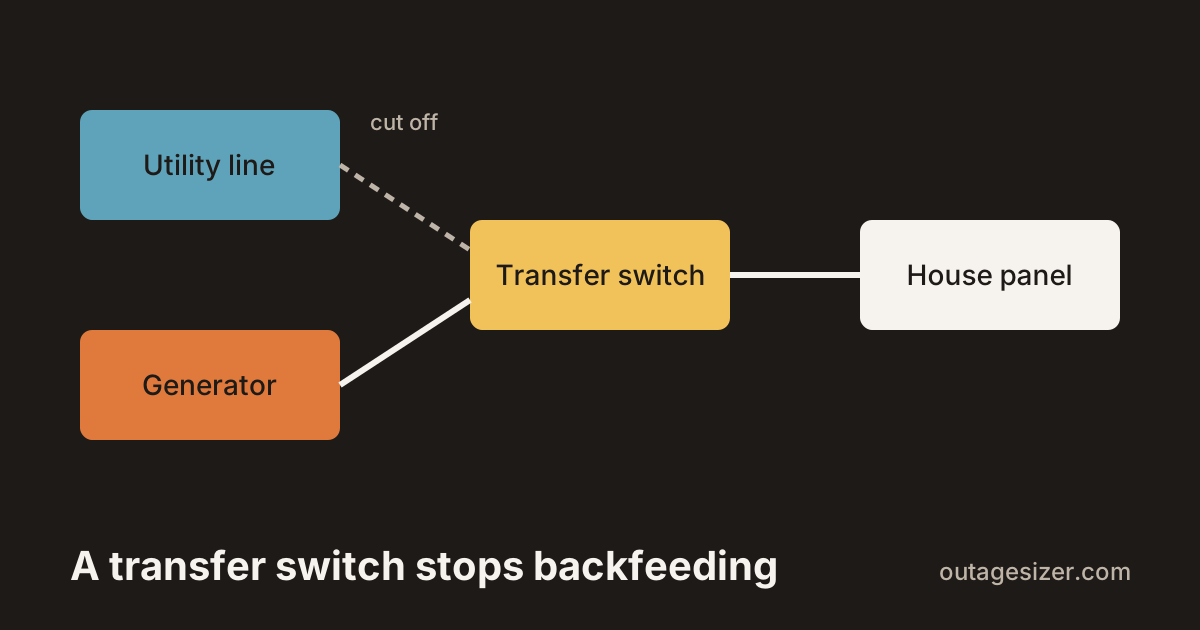
A transfer switch is the only safe way to connect a generator to a house's wiring. It disconnects the house from the utility line before the generator is connected, so generator power cannot flow back out onto the street. Plugging a generator into a wall outlet skips that step, and it is called backfeeding.
Why backfeeding is dangerous
The CPSC tells generator owners: "NEVER try to power the house wiring by plugging the generator into a wall outlet, a practice known as "backfeeding."" It explains that backfeeding presents an electrocution risk to utility workers and neighbors served by the same utility transformer. OSHA: "Attaching a generator directly to a building electrical system without a properly installed transfer switch can energize wiring systems for great distances. This creates a risk of electrocution for utility workers and others in the area."
The danger runs outward. A line crew working on a downed line expects it to be dead, and a neighbour on the same transformer can be put at risk too.
What OSHA, FEMA and DOE say to do
- OSHA: "Never attach a generator directly to the electrical system of a structure (home, office, trailer, etc.) unless a qualified electrician has properly installed the generator with a transfer switch."
- FEMA: "Use a qualified electrician to install the appropriate equipment in accordance with local electrical codes or ask your utility company to install an appropriate power transfer switch."
- DOE Building America Solution Center: "Engage an electrician to install safe and reliable transfer switches (manual or automatic)"
The options
Extension cords only. Appliances plug directly into the generator's outlets with outdoor-rated cords. No wiring changes, but hard-wired loads — a furnace, a well pump, a sump pump on its own circuit, central air — cannot be reached this way.
Manual transfer switch or interlock. An electrician installs an inlet outside and a switch or interlock at the panel. You start the generator, flip the house over, and turn on the circuits you chose. This is how a portable generator runs a furnace or well pump.
Automatic transfer switch. Standard with home standby generators: it senses the outage, starts the generator and moves the house over, then moves it back when utility power returns. Generac's spec sheets list service-rated automatic transfer switches for each Guardian size.
How the switch changes the sizing
With cords, you size for whatever you plug in. With a transfer switch, every circuit the switch can turn on becomes part of the list, including 240-volt loads such as a well pump or water heater. That has two consequences:
- The generator must supply 240 volts. Of the six portables on this site, Honda lists only 120-volt output for the EU2200i and EU3000iS; the EU7000iS lists current at both 120 and 240 volts.
- The starting surge of the biggest motor on any switched circuit sets the starting capacity. A well pump or central air conditioner often becomes the largest surge in the house.
Work the list through the calculator with the hard-wired loads included, then compare with the portable and standby pages. Whatever generator you choose, connect it to the house only through a transfer switch.
Sources
- U.S. Consumer Product Safety Commission, Portable Generator Hazards safety alert (pub. 5123)
- Centers for Disease Control and Prevention, Use a Generator Safely
- Occupational Safety and Health Administration, Using Portable Generators Safely (OSHA 3286)
- Federal Emergency Management Agency, Be Safe During a Power Outage
- U.S. DOE Building America Solution Center, Generators for Back-up Power During Outages
- Generac Guardian 10/14/18 kW spec sheet
Questions
Can I plug my generator into a dryer outlet?
No. That is backfeeding, and the CPSC and OSHA both warn against it because it can energize the utility lines and electrocute line workers.
Does a portable generator need a transfer switch?
Only if it is going to feed house circuits. Appliances plugged straight into the generator with outdoor extension cords do not need one.
Who installs a transfer switch?
OSHA says a qualified electrician; FEMA adds that the utility company can install one.