Running vs Starting Watts: How to Size a Generator
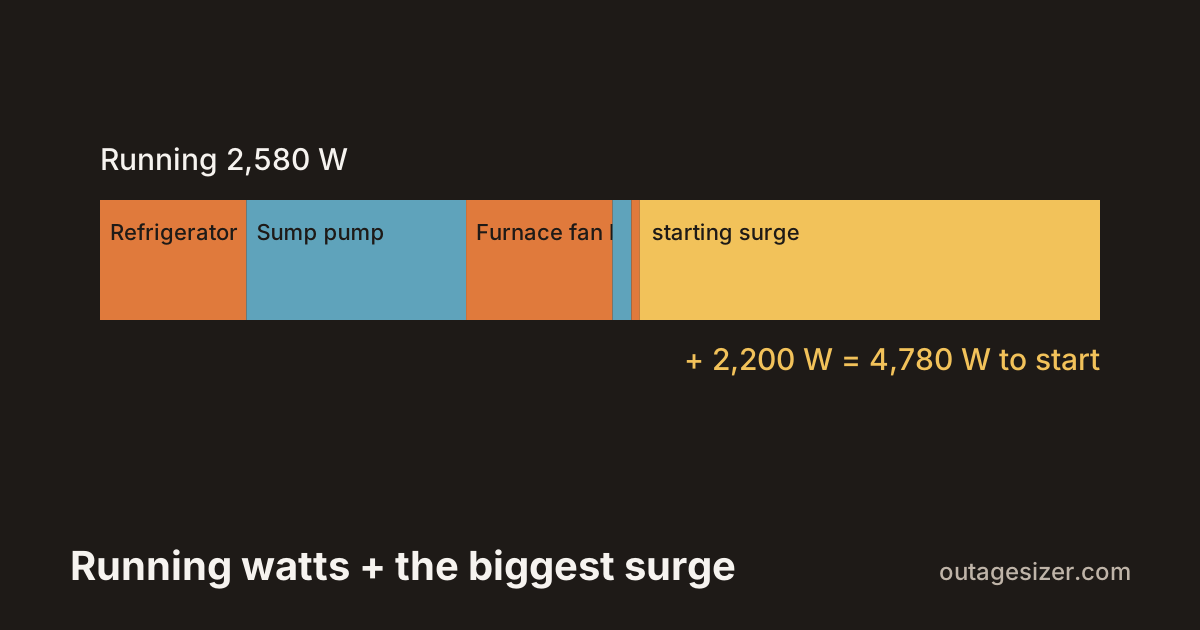
Running watts and starting watts are the two numbers that decide what size generator a house needs, and they work differently. Running watts are what a device draws once it is going. Starting watts are the extra power a motor pulls for the few seconds it takes to get up to speed.
The method every table prints
The three appliance tables this site uses — Generac GP brochure (2023), EWEB (2019) and Champion flyer (2021) — all print the same three steps:
- List what you want to run at the same time and add up the running watts.
- Find the one device with the highest additional starting watts.
- Add that single figure to the running total. The result is the starting capacity the generator needs.
Generac's brochure puts it as "Select the one device with the highest starting watts. Add that number to the total running watts to determine the total wattage requirement." Generac's standby sizing page uses the same rule for home standby units. Only one surge is added because the motors are assumed to start one after another, not all at once.
A worked example
A typical outage list: a refrigerator, a 1/2 hp sump pump, a 1/3 hp furnace fan, six 15 W LED bulbs and two phone chargers.
| Device | Running W | Additional starting W |
|---|---|---|
| Refrigerator/freezer | 700 | 2,200 |
| Sump pump, 1/2 hp | 1,050 | 2,150 |
| Furnace fan, 1/3 hp | 700 | 1,400 |
| LED bulbs, 6 × 15 W | 90 | — |
| Phone chargers, 2 × 20 W | 40 | — |
| Total | 2,580 | largest: 2,200 |
Starting capacity needed: 2,580 + 2,200 = 4,780 W. A generator rated 3,900 W running and 5,000 W peak covers it; one rated 2,800 W running and 3,000 W maximum covers the running load but not the start. If you added every starting figure instead, you would arrive at 8,330 W and buy a far bigger generator than the method calls for.
Additional or total?
Not every table means the same thing by "starting watts". The three used here print additional starting watts, the surge on top of running watts — EWEB's column is headed "Additional Starting Watts" and Champion's own worked example adds 2,200 to 3,880. Other charts print total starting watts, which already include the running figure. Mixing the two conventions double-counts the running watts. A starting figure smaller than the running figure must be additional, since a total cannot be below the running load; otherwise read the column heading.
Why the tables disagree
The same appliance can carry very different figures from table to table:
- A 12,000 BTU window air conditioner is 3,250 W running and 3,950 W starting in Generac's and EWEB's tables, but Champion lists an unsized window unit at 1,200 W and 2,000 W.
- An electric water heater is 4,500 W in EWEB's table and 2,000 W running in Generac's.
- A coffee maker is 1,500 W (Generac), 1,000 W (EWEB) or 800 W (Champion).
These are typical figures for typical products, and products vary. The nameplate on the appliance — volts × amps = watts — beats any table. For motors, the label's locked-rotor amps (LRA) tells an installer how hard the start will be.
Reading a generator's ratings
Generator makers name their models by different numbers. Honda's EU7000iS is rated 5,500 W continuous and 7,000 W maximum; Champion's 7,500-watt dual-fuel model is rated 7,500 W running and 9,375 W starting. Compare your running total with the running rating and your starting total with the peak rating. A home standby generator has a single rating and, in Generac's words, "no overload capability", so it must cover the starting total outright — see standby generator sizes.
The calculator runs this method on your own list, and the appliance pages show it one device at a time. Size for running watts plus the single biggest starting surge, and the generator will start everything on the list.
Sources
- Generac GP Series portable generator brochure (doc 201908122, 2/2023), wattage reference table
- Eugene Water & Electric Board, Generator Sizing Considerations (May 2019)
- Champion Power Equipment, Choosing a Generator / Quick Reference Wattage flyer (2021)
- Generac, What size generator do I need?
Questions
Do I add up all the starting watts?
No. The published method adds every running figure and then only the single largest additional starting figure, on the assumption that motors start one at a time.
Is a generator's peak rating the same as starting watts?
Makers use peak, maximum or starting for the short-term rating. It is the figure to compare against running watts plus the biggest surge; the running rating is the one the generator can hold.
What if my appliance's label disagrees with the table?
Use the label. Volts times amps gives running watts, and the tables are only typical values.